The Value We Create — and Almost Never Keep for Ourselves
In IT we create value every single day: we fix prod, cut risk, clear out the chaos. Yet almost none of us actually owns the result. A look at an uncomfortable paradox — without the drama.
December 30th is a strange day. Technically it's still work, but the New Year mood has already taken over. And it's on days like this that one simple, deeply uncomfortable thing becomes especially clear: in IT we constantly create value — and almost never keep any of it.
December 30th, when everything is easy to see
Someone's tying up loose ends, someone's stocking up on tangerines, someone's trying to catch the "last call of the year" so they can honestly slip into full olivier-and-herring-under-a-fur-coat mode. A good backdrop for turning away from the task tracker for a second and thinking about the thing it's more comfortable to ignore on ordinary days.
We do this every day. Every release. Every night when we "just need to drag it a little further." We raise stability, speed up calculations, cut costs, clear out the chaos, rescue prod and haul systems out of the swamps nobody else wanted to wade into. And all of it stays behind. The system keeps living, the product grows, the business gets its effect, the reports look prettier, and the metrics get cheerier.
And now the uncomfortable part. Almost none of the people who did all this own the result — not legally, not economically, not even morally. Because within a couple of months, a year at most, your heroic architecture starts being perceived as "it was always like that." There was no heroic feat. The system just works. Well, it works, so it works.
You're building an asset, but it isn't your asset
Let's get concrete, without the pathos.
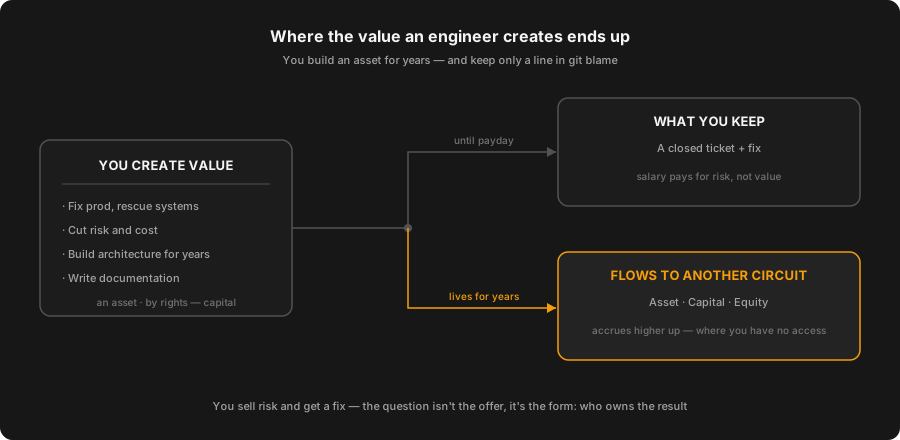
You can pour a month into an architectural decision that will feed the product for three years. You can redesign a chunk that cuts risk by serious money — not "we saved on coffee," but sums that in another context earn people bonuses and promotions. You can put together the documentation without which literally no one would understand how the thing works or why you don't touch it on Fridays.
All of that is an asset. Honestly, capital. But in the current model it isn't capital and it isn't a share. It's "completed tasks." Ticket closed, thanks, nice one, next. The value you created went off to live its own life — and you're left with a closed ticket and a faint sense that you got shortchanged somewhere, though you can't quite say where.
In practice it looks roughly like this. You join a project that's "a bit on fire." You spend six months firefighting, stabilizing, rewriting the bottlenecks. A year later the project is the pride of the department, people talk about it at internal meetups, they show it off to clients. And you, in that story, are a line in git blame. Useful, but nameless.
And it's not that "they specifically underrated me." It's built this way for everyone. The person who designed the payment flow and the person who then keeps it afloat for three years both stay on a fixed salary — while the value that flow generates lives in reporting at an entirely different level. It's not a conspiracy and it's not greed. It's just the default shape of an employment relationship, one we've gotten so used to that we've stopped noticing it.
A salary pays for risk, not for value
In IT it's customary to think a salary pays for labor. In practice it more often turns into payment for the risk and strain you take onto yourself so the system even survives to the next release and the next year.
The difference is subtle, but it matters. You're not paid for how much value you created. You're paid for agreeing to carry that value on your shoulders — to be the one they call at three in the morning when everything goes down. It's a fair deal, no argument. But the value you create along the way doesn't accumulate with you. It accumulates somewhere higher up, in another circuit you don't have access to — only a view from a distance.
The engineer as a log in the system
Sometimes it feels to me like an engineer's value in this construction works like a log. It's useful while it's fresh: you can use it to understand what happened, reconstruct the picture, find the cause. Then it gets archived. And at some point retention comes along and deletes it entirely — because "it takes up space and nobody looks at it anyway."
The metaphor is cruel, but recognizable. Your contribution is valuable exactly as long as it's visible and fresh. After that it becomes part of the background. "It was always like this." And you go off to create the next batch of logs, which the same fate awaits.
The paradox many feel in their bones
From this comes the very paradox many people feel physically but rarely put into words.
You get more experienced. The systems you're responsible for get more expensive and more complex. Responsibility grows. But the feeling of "I'm building my own future" somehow doesn't keep pace with that growth. If anything, the opposite — the higher the stakes, the sharper the sense that the stakes aren't yours.
And this isn't about ingratitude, and it isn't about "I don't get paid enough." It's about structure, not about a specific boss or a specific company. You're building the system's future — reliable, scalable, beautiful. But not your share in that future. Your share ends on the 25th.
What to do about it (and why not today)
December 30th is a good day to honestly acknowledge this. Without the drama, without the ranting, without revolutions and without "meanwhile, in normal countries." Just admit the fact: if you spend years creating value and you have no mechanism for holding onto it, then at some point you'll inevitably start looking for a different way.
And that "different way" isn't about motivation. Not about a new course on systems design, not about meditation, and not about yet another offer with +20% to your salary. An offer changes the number, but it doesn't change the construction itself: you're still selling risk and getting a fixed rate. "Different" is about form. About who owns the result and how the distribution of what the team built together is set up. That's exactly what the manifesto and the conversation about cooperation in IT are about: not "getting hired" and not "hiring," but owning the result of your own work.
But let's not spoil the New Year backdrop with heavy words right now. The topic is serious, it isn't going anywhere — we'll come back to it in January, with a clear head.
For now let's just set the thought on a shelf. Next to the tangerines. Next to a quiet understanding that we'd like to live the coming year not only "in releases," but also accumulating something of our own.
Happy New Year in advance. May the coming year bring you not just green prod, but also something that stays with you.
Originally published on my Telegram channel @it_underside.
Yours, DPUPP
Related Articles
Cooperative vs Employment: A Conversation the Community Was Ready to Have
Notes from conversations with RAD-KOP, a Russian cooperative IT community. Not 'here's my pitch' but 'here's where the dialogue took us': a comparison of models, real-world examples, and an honest look at the downsides.
The Value We Create — and Almost Never Keep for Ourselves
In IT we create value every single day: we fix prod, cut risk, clear out the chaos. Yet almost none of us actually owns the result. A look at an uncomfortable paradox — without the drama.
Red Flags in Hiring, Through a Lead's Eyes
Behavioral patterns in candidates I've learned to spot over years of hiring. Not an HR checklist, but the view of a manager who builds teams.