Toxicity in Tech: How Not to Shrivel Up and Stay in the Game
Toxic teams kill your career faster than a stale résumé ever will. Here is what not to do and what actually works — for both engineers and managers.
The setup: St. Petersburg, Highload 2024
I'm heading to St. Petersburg for Highload. Prepping to talk about architecture: how not to spin out, and the cool stuff we pulled off when you've got more microservices than you have hairs on your head (kidding, no offense taken).
Gave the talk — went exactly as planned: applause, questions. But the real fun started afterwards — in the hallways, over coffee, in actual conversations.
Spent a few hours with folks from different companies — "bank #1", "telecom #2", "corporation #3" (let's keep it that way so nobody comes after me later). And it turned out: everyone shares the same pain, the one nobody talks about from the stage. Not Kafka, not Flink. Toxicity in teams.
What even is toxicity?
Forget the word "strictness." Toxicity is not "they keep us on our toes."
It's when after work you feel not "pleasantly tired" but wiped to zero. And before long, you find yourself booking appointments with specialized doctors.
The classics of the genre:
- fines for bugs ("for discipline," sure) — and not just in the code, but in the docs too,
- gaslighting — when you're methodically and "gently" convinced that "it's your own fault,"
- bonuses that get "eaten" even though you dragged the project through with your teeth,
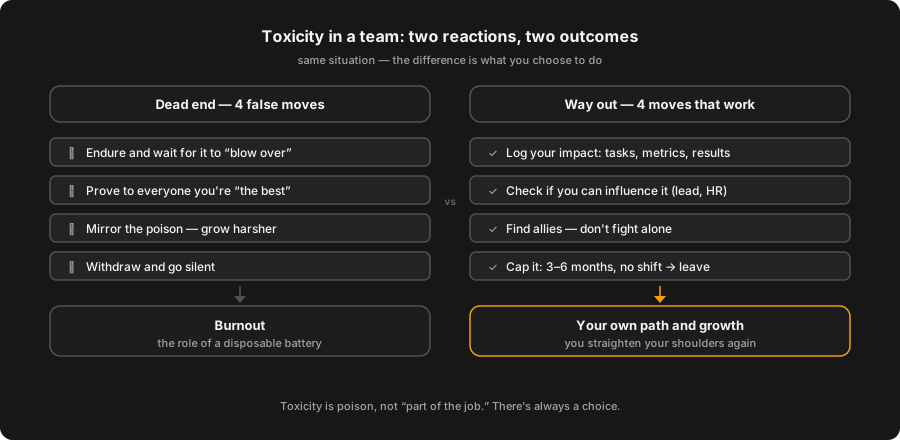
- the all-time favorite: you hand in your resignation → "Stay, we need you, we won't make it without you" → you drag the release across the line → and a couple of months later you're tossed out: the role of "disposable battery" has been played out.
Why this is genuinely dangerous
This isn't just an unpleasant background hum. It's a factor that kills your career faster than a résumé with no updates.
An hh.ru study (2021) recorded that 43% of employees had experienced burnout, and the main trigger wasn't overwork — it was precisely the atmosphere in the team.
Toxicity breaks more than projects — it breaks people. Even strong ones...
What you absolutely must not do (I'm not a doctor lol)
- Endure and wait for it to "pass on its own." It won't.
- Prove to everyone that "I'm the best." In a toxic environment the best don't get rewarded — they get squeezed dry. And then something breaks in your subconscious, too...
- Mirror the toxicity. Getting even harsher means spinning the same vicious circle.
- Withdraw and go silent. Internal emigration gives the appearance of protection, but in practice it just speeds up the burnout.
What you can and should do
If you're an engineer
- Document your contribution. A separate file: tasks, metrics, results. Though, honestly, it doesn't always help...
- Check whether you can actually influence the environment (a talk with your lead, HR). If it's a dead end — that's the diagnosis. You didn't hear this from me — run!
- Find allies. Going up against a culture solo is a bad bet. Just be careful, you might be in the minority)
- Set yourself a time limit: 3–6 months. If nothing changes — time to look around. Although you should probably start thinking now: not everyone can take that level of pressure...
If you're a manager
- Don't pass the poison down the chain. Your "I get pressured, so I pressure others" kills the team.
- Remove toxic behavior surgically. Not people — patterns: public humiliation, fines instead of feedback.
- Criticize the process, not the person. Mistakes should be a lesson, not a sentence.
- Build a culture of growth, not fear. People stay where they feel respected.
A personal note
Why am I writing this? Because I've seen it with my own eyes.
I came to St. Petersburg to talk about one thing, and we ended up discussing something else entirely. And that's telling: we talk about technology loudly, from the stage, but about toxicity — in a whisper, over coffee.
I've been in situations myself where bonuses got "eaten" and people tried to "shrink" me down. And I've seen how, after the right turn, people instead straighten their shoulders and start to grow.
The bottom line
Toxicity is not "part of the job." It's poison.
Ignoring it means agreeing to be a disposable battery.
There's always a choice:
- either you burn out for someone else's system,
- or you start building your own path.
And yes — the road from point A to point B can take a year. It can take three. Or you can sit on point A your whole life, if you believe that "it's like this everywhere."
Originally published on my Telegram channel @it_underside.
Yours, DPUPP
Related Articles
Toxicity in Tech: How Not to Shrivel Up and Stay in the Game
Toxic teams kill your career faster than a stale résumé ever will. Here is what not to do and what actually works — for both engineers and managers.
Cooperative vs Employment: A Conversation the Community Was Ready to Have
Notes from conversations with RAD-KOP, a Russian cooperative IT community. Not 'here's my pitch' but 'here's where the dialogue took us': a comparison of models, real-world examples, and an honest look at the downsides.
The Value We Create — and Almost Never Keep for Ourselves
In IT we create value every single day: we fix prod, cut risk, clear out the chaos. Yet almost none of us actually owns the result. A look at an uncomfortable paradox — without the drama.