IT Conferences for Analysts: A Practitioner's Guide
Why analysts should go to conferences, how to squeeze the most out of them, and which venues are worth your time and money. A rundown of 20+ conferences from the experience of a speaker and the lead of a 2,000+ member community.
November 2021. HighLoad++ in Moscow. I'm standing in the coffee line between sessions and strike up a random conversation with a guy in a black hoodie. We get into event sourcing — he tells me how his team got burned by eventual consistency in a payment system, I tell him how we built a data platform at a bank. Twenty minutes later we're sitting on a windowsill, sketching architecture diagrams on a napkin. Three months later that conversation leads to me getting recommended for a role that shaped the next three years of my career.
I wasn't planning to network. I didn't prep an elevator pitch. I was just standing in line for a cappuccino.
Since then I've spoken at HighLoad++, Analyst Days, Infostart, LAF, Saint HighLoad++ and a few other venues. I run an analysts' community that has grown to more than two thousand people. And I can say with full confidence: conferences changed my career more than all the courses and certifications put together.
Why You Should Actually Go to Conferences
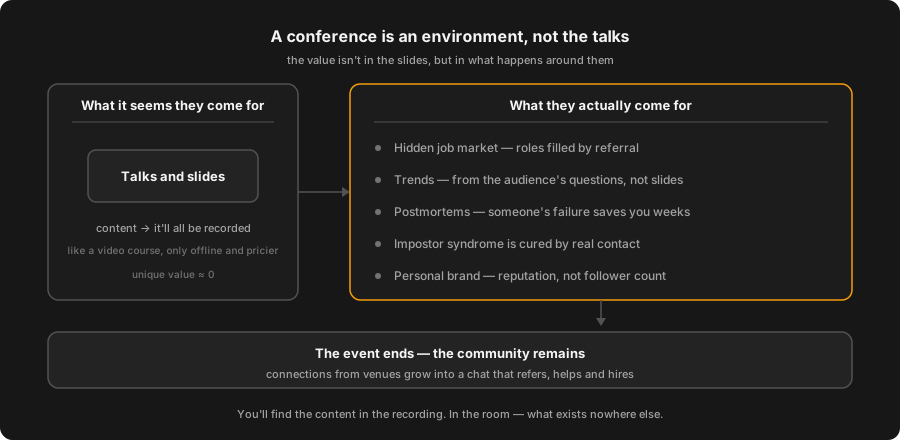
When I first went to a conference, I thought the main value was in the talks. Show up, listen, jot down some notes, leave. Like YouTube, only offline and more expensive. I was wrong. You'll find the content in the recordings. A conference is an environment where things happen that are impossible in any other format.
The Hidden Job Market
The best positions never show up on job boards. They get filled through referrals. When a manager is looking for a lead, the first thing they do is ask around: "Know anyone good?" Conferences are where that "around" gets built. I personally know people who landed key career positions through connections they made at conferences. One of them is me — thanks to that conversation over coffee.
The mechanics are simple: you give a talk, someone comes up, you discuss a problem, six months later they message you on Telegram. No magic. But for that to happen, you have to be in the room.
Trends Come From the Questions, Not the Slides
A talk tells you about a technology. The questions from the audience tell you which problems the industry actually cares about. When the same topic comes up in the Q&A at three different conferences — that's a trend. Not from the Gartner Hype Cycle, but from the trenches.
A recurring topic at conferences over the last few years: the shift from batch to real-time in the enterprise. Two years ago only a handful of people asked about it. Then it was every other person. That tells me more than any analyst report. I build real-time systems — and I know the trend is real, because I hear the same pain points from different companies.
Postmortems Beat Masterclasses
The best talks aren't about wins — they're about failures. When a speaker honestly walks you through how their team lost a week to a bug that only showed up under load, you remember it. And when you hit the same thing yourself, you'll recall it. One postmortem like that can save your team weeks of work.
Talks in the "we rolled out ML and conversion jumped 40%" genre are pretty but useless. You don't know the context, you don't know how many times the model flopped before that. But "we spent three months building an ML model, it turned out worse than a simple heuristic, and here's why" — that's real value.
Impostor Syndrome Is Cured by Real Contact
Everyone in IT has that moment when it feels like everyone around them is smarter. Then you go to a conference and you see it: the people you thought were gurus are wrestling with the same problems. The same bugs, the same fights with the client, the same hiring headaches.
When a few people come up after your talk and say "we've got the exact same problem — how did you solve it?" — that's the best medicine there is. Turns out your experience isn't trivial. Somebody actually needs it.
A Personal Brand Isn't Built on Social Media
You won't become famous after your first talk. But you will become "that guy who talked about NER at a bank" to thirty people. Next time, to a hundred. In a year, people recognize you. In two, they invite you. A personal brand in IT isn't followers — it's your reputation among the people whose opinion actually matters. Conferences are the launch pad.
A Map of Conferences: Where to Go
Over years of attending and organizing, I've put together my own map of venues. Here's my subjective take — from the audience and from behind the scenes.
| Conference | Scale | Talk Quality | Networking | Who It's For |
|---|---|---|---|---|
| HighLoad++ | 3000+ | High, strict selection | Excellent | Architects, tech leads, seniors |
| Analyst Days | 500-800 | High, specialized | Good | Analysts of all levels |
| TeamLead Conf | 1000+ | Good | Excellent | Team leads, managers |
| Saint HighLoad++ | 1500+ | High | Good | Same profile, St. Petersburg crowd |
| Infostart | 1000+ | Medium, but strong management tracks | Good | 1C ecosystem + managers |
| LAF | 200-300 | Good, niche | Excellent (intimate) | Leads and analysts in finance |
| PyCon Russia | 500+ | Good | Good | Python developers |
| Meetups / local | 30-50 | Varies | Best for starting out | First-time speakers |
Big multi-format events — HighLoad++, Analyst Days, TeamLead Conf. Strict program-committee selection. If you want to speak, prep your submission three or four months out, and be ready for three rounds of edits.
Niche events — Infostart, LAF, PyCon. Smaller scale, but a deeper dive into the topic. Easier to get onto the program as a speaker. This is exactly where I cut my teeth as a speaker — the audience is friendlier, the feedback is more concrete.
Meetups — often underrated, but they're the perfect training ground. Thirty people, a friendly vibe, questions after the talk. If a big conference scares you, start with a meetup. After two or three talks the fear goes away.
How to Squeeze the Most Out of It
Most people go to conferences the wrong way. They try to hit every single talk, end up overloaded with information, and leave with mush in their heads. Here's what works better.
Before. Study the program. Pick three or four talks that are genuinely relevant to your work. See which speakers interest you — you can message them on Telegram ahead of time and arrange to meet. Seriously — speakers are usually glad when someone comes with a specific question rather than "tell me something interesting."
During. Alternate between sessions and hallway conversations. The most valuable talks happen at the coffee stands, not in the halls. Don't write down the talk's key points — they'll be in the recording — write down your own thoughts: what applies to your project, who to talk to, what to try on Monday.
After. Within a day, message everyone you exchanged contacts with. Not "nice to meet you," but something specific: "We talked about your approach to event sourcing — I want to try it at our place, mind if I ask you for advice?" Specifics turn a chance encounter into a working contact. Abstract politeness doesn't.
Community > Conference
A conference is an event. A community is a process. Telegram channels, professional chats, regular meetups — all of it is a continuation of the connections made at conferences.
My analysts' community has grown to more than two thousand people. It's not just a chat — it's an ecosystem where people share experience, help with tasks, refer each other for positions, and organize joint activities. Most members came in through conferences — they met at a venue and kept talking in the chat.
A concrete example. Friday evening, an analyst from a fintech company writes to the chat: "Guys, we've got an integration with an external service over SOAP, the docs are in Chinese, and the deadline is Monday. Has anyone parsed WSDL from Chinese payment systems?" Twenty minutes later, three people chime in. One drops in his own parser. Another shares the contact of someone who did a similar integration a year ago. A third sends a link to a repo with examples. By Monday the integration works. Try getting that kind of help on StackOverflow on a Friday night, Moscow time. But in a community where everyone knows each other at least by their handles — that's just a normal situation.
Another case: someone found a job through the community. Not through a job posting — through a discussion. For several months he answered questions about process analysis, gave thorough answers, shared documentation templates. When a lead-analyst position opened up at one of the companies, three chat members recommended him — independently, without coordinating. Because everyone had seen his expertise in action, not on a résumé.
Investing in a community has the highest long-term return in your career. Higher than courses. Higher than certifications. Because a community is real people with real experience, and access to that experience can't be bought with money.
A War Story: When a Talk Goes Off the Rails
At one of the niche conferences, the thing every speaker dreads happened to me. I put up a slide with an architecture — and a guy stands up in the audience. He doesn't ask a question — he makes a statement: "This architecture is wrong. We did something similar and the whole thing fell over." The room went quiet. Two hundred pairs of eyes on me.
My first impulse was to defend myself. The second — which came a second later — was to accept it. I said: "Tell me what fell over, and under what conditions." He told me. It turned out they had a different load, different SLAs, different infrastructure. His experience was valid — for his context. Mine was valid for mine. We spent ten minutes discussing the differences right there in the room. The moderator was getting nervous, the timing slipped, but the audience was engaged in a way you never get with the usual "slides and questions" format.
After the talk, several people came up and told me that live discussion was more useful than the talk itself. The guy from the audience and I kept messaging for a month afterward — he tossed me a couple of ideas that genuinely influenced our project. And I learned my lesson: the best moments at conferences are the unplanned ones.
Now be honest: do you still think conferences are about "listening to talks"? Then you're standing in the coffee line and not talking to the person next to you. And maybe, three months from now, that person changes your career.
If you want to learn more about my talks and topics, check out my speaking page.
Original article: IT Conferences for Analysts on Habr
Yours, DPUPP
Related Articles
Cooperative vs Employment: A Conversation the Community Was Ready to Have
Notes from conversations with RAD-KOP, a Russian cooperative IT community. Not 'here's my pitch' but 'here's where the dialogue took us': a comparison of models, real-world examples, and an honest look at the downsides.
Red Flags in Hiring, Through a Lead's Eyes
Behavioral patterns in candidates I've learned to spot over years of hiring. Not an HR checklist, but the view of a manager who builds teams.
Fintech Development: 7 Circles of Hell
An honest guide to what awaits your team when shipping a product to production at a major bank. From hiring to support — every stage is a challenge of its own.