DPUPP on a Weekend: The Kremlin, a Family Release, and Sunday Alerts
A Sunday walk through central Moscow seen through the eyes of an engineer who spent too long working from home. Family as a distributed system, the Kremlin as production, and a quiet thought about why you should step away from the monitor at all.
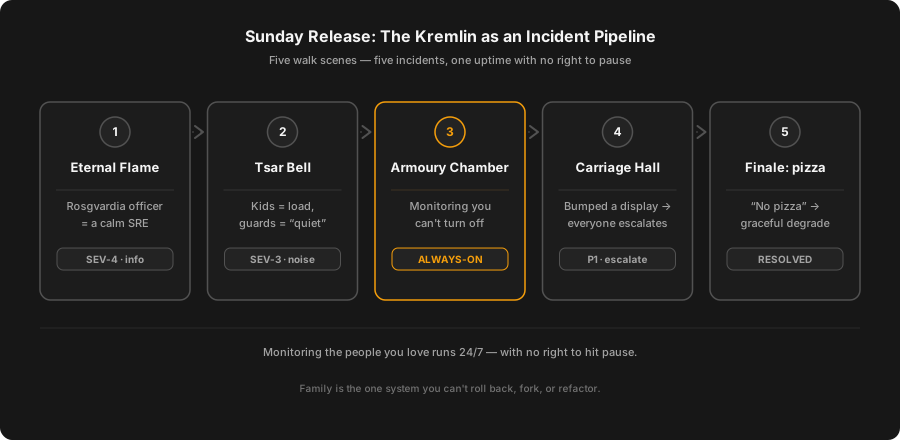
Sometimes the best way to realize you've fused with your job is to step outside and catch yourself looking at actual human beings as if they were a distributed system. Here's one Sunday from the life of an engineer who hasn't seen the production environment called "reality" in a long time.
Sunday. The main releases are shipped, the on-call is quiet, the chat is suspiciously silent. And I — an engineer gone slightly feral on remote work — decide, for the first time in ages, to go offline. My wife doesn't ask; she initiates a command:
"Let's go for a walk in central Moscow."
Command accepted, no confirmation required, no arguments entertained. The release is rolling out.
Let me say something anyone who's worked from home for months will get. Remote work quietly turns you into a background process: you're technically alive, but you loop through "call — task — call," and the outside world is just a browser tab you forgot to close. Then you step outside and your brain is still in production. It doesn't know how to just look at monuments — it hunts for metrics, alerts, and points of failure. This is called occupational deformation, and the only cure, it seems, is family and fresh air. Or it isn't cured at all — it just gets funnier.
Scene one. The Tomb of the Unknown Soldier
My youngest decided to stress-test the durability of the chain on the railing — by hand, checking it for structural integrity, like a real QA who doesn't trust the docs and goes in to break things himself. A National Guard officer came over. Calmly, no escalation, no raised voice — like a seasoned SRE dragged out of bed at 3 a.m. who's still polite, because he's a professional. He made his remark with respect for the regulations and not a single wasted word.
And I caught myself thinking: if corporate support at every company reacted like that — level, on point, no drama, no passing the ticket to the next department over — we'd probably forget what a blown release and a midnight "who shipped this?" call even feel like. There's a lot to learn from a person who just does his job and doesn't turn an incident into a performance.
Scene two. The Tsar Bell
Next, the kids decided to run a load test on the acoustics. One shouted, the second happily joined in, the third was already drawing breath for the next iteration — and that's when a guard interrupted the loop:
"Quiet within the walls of the Kremlin."
I get it. You don't run tests in production — you run load tests on a staging rig, not on monuments of federal significance. I nodded gratefully. Fair enough, all by the book. But between us, it was fun — and I quietly envied how easily kids launch experiments without asking permission or filing a ticket. In our world that's called "shipping without review," and it usually blows up in your face.
Scene three. The Armoury Chamber
My eldest reaches for the Fabergé eggs — not to steal one, just to touch it, to confirm it's real. Security triggers. Internally I kick off a rollback and think: well, at least the alerts are stable, the response is instant, and there are no false positives.
The youngest watches all this and whispers:
"Dad, is that monitoring?"
"Yes, son. Only with no right to switch it off."
Honestly, that's the best metaphor for adult responsibility I've heard all year. In a healthy system you can silence an alert, mute notifications for the weekend, put someone on call. And then there's the monitoring that runs always: for the kids, for the people close to you, for keeping everything okay. You can't pause it, and honestly, you don't really want to.
Scene four. The Hall of Carriages
My wife is enthusiastically explaining the history of Russia to the kids, and mid-inspired-gesture she lightly brushes a display case. A new incident triggers. Now the alert isn't about the kids anymore — it's about all of us at once. Escalation to the entire team.
An officer of order approaches with a face at P1 Priority level: not angry, but focused, ready to dig in. And mentally I thank him for his composure, because everyone has a firing threshold, especially on Sundays, especially when families with kids have been streaming past for the fifth hour straight, each one itching to brush against something. Holding an even tone under those conditions is a separate skill — one nobody puts on a résumé, but one worth more than half your hard skills.
Scene five. Wrapping up the release
The kids are spent, my wife is smiling, everyone's battery is at minimum, and the only living KPI at this moment is to make it to the pizza. A simple, clear, measurable goal — every product manager's dream.
We walk into a little restaurant. I open the menu with the gaze of a hungry man who kept a system in uptime all day, and I see a sign: "No pizza." I felt an internal drop connection — the exact kind you get when a service you were counting on silently falls over at the worst possible moment. But the degradation turned out to be graceful: lasagna with dessert shipped to production flawlessly, and we routed around it for the evening.
The system stabilized. Monitoring is green. Incidents closed, no postmortem required.
Moscow as production
And then you're sitting there with a cup of coffee, across from two tired microservices that dutifully generated load all day, and next to the person thanks to whom this whole architecture holds together at all. And you catch the very thought this whole thing was apparently for.
Moscow is like production. Sometimes it's noisy, sometimes it triggers, sometimes it returns "no pizza" instead of the expected response. But it's alive and beautiful, and everything in it is for real — unlike your cozy home rig, where you control every variable and slowly go numb because of it.
Occupational deformation is a funny thing, but it has a flip side. It reminds you that all these metaphors about alerts, rollback, and SLAs are the language you use to describe what actually matters to you: keeping the system alive, keeping the people around you okay, keeping everything from crashing at the worst possible moment. It's just that at home you spend that skill on code, when sometimes you should spend it on reality.
Family is the only system you can't refactor, fork, or roll back to a previous version. You can only keep it running in battle, day after day, with no weekends off call. And honestly, it's the most meaningful uptime I've ever held.
So if you're reading this right now without looking away from your monitor on your rightful day off — just close the laptop and step out into your own personal center of Moscow. Production can wait. Those tired microservices across from you? Not so sure.
Originally published on my Telegram channel @it_underside.
Yours, DPUPP
Related Articles
DPUPP on a Weekend: The Kremlin, a Family Release, and Sunday Alerts
A Sunday walk through central Moscow seen through the eyes of an engineer who spent too long working from home. Family as a distributed system, the Kremlin as production, and a quiet thought about why you should step away from the monitor at all.
Cooperative vs Employment: A Conversation the Community Was Ready to Have
Notes from conversations with RAD-KOP, a Russian cooperative IT community. Not 'here's my pitch' but 'here's where the dialogue took us': a comparison of models, real-world examples, and an honest look at the downsides.
AI в разработке: 30-60% ускорения — реальность или хайп?
Практический опыт использования AI-инструментов и LLM-агентов в enterprise-разработке и pet-проектах. Где AI реально ускоряет, где создаёт иллюзию, и как встроить его в процесс.